

Influence of local food effort is tiny but industrial agriculture is
blasting ahead at a great rate, says author, farmer and activist
Monday, October 28, 2019
Belz Mein Shtetele Belz (My Home Town) - Yiddish Song To Herb Alpert Instrumental
Evolution of a song -
Neus Català, Freedom Fighter
Neus Català, fighter against fascism in Spain and France, dies at 103
April 26, 2019 at 5:08 p.m. EDT
During
that conflict, she did not carry a weapon but supported the republican
soldiers fighting Franco’s ultimately successful nationalists. In
France, she was armed. “We women were not assistants,” she later wrote in a memoir, “we were fighters.”
Fleeing
Spain for neighboring France in 1939, she joined the French resistance
when Hitler’s forces invaded in May 1940. Working with her new husband,
Albert Roger, a Frenchman, she carried weapons, falsified documents or
messages under a headscarf or under a basket of vegetables on her
bicycle, charming her way through Nazi checkpoints.
After
a French collaborator betrayed her, she was arrested by the Gestapo in
November 1943 and deported to the women’s concentration camp at
Ravensbrück, north of Berlin, while her husband was sent to
Bergen-Belsen, also in Germany.
From
Ravensbrück, Ms. Català was moved to another concentration camp at
Flossenbürg, Bavaria, near the Czechoslovakian border, where she was
part of a forced labor group quarrying granite as well as making parts
for fighter planes and ammunition.
Ms.
Català persuaded her fellow female workers to boycott or disrupt
weapons production, and they became known by their Nazi guards as “the
Lazy Kommando.”
“We
boycotted everything we could in the manufacture of weapons,” she
recalled in 2013 to the magazine of the General Union of Workers, a
Spanish trade union. “We used sabotage to produce about 10 million
faulty bullets and thousands of unusable artillery shells. We threw
everything into the production line — flies, cockroaches, oil, our own
spit. The Nazis called us ‘Snow White and the Seven Mechanics’ because
they constantly had to come to fix our machines.”
Approximately
30,000 prisoners died in Flossenbürg from malnutrition, overwork,
executions, or during the death marches forced on them by the Nazis as
the Allies approached. Roger died within days of liberation in 1945.
When
Ms. Català was freed around the same time, she was critically ill. “We
were just skulls with eyes,” she told the trade union magazine. “I was a
bag of bones.” Yet she survived for almost 75 more years, dying April
13 in a nursing home in the Spanish village of Els Guiamets, her
daughter Margarita Català announced. She did not provide a specific
medical cause.
Neus
Català Pallejà was born in Els Guiamets in Catalonia, where the
northeastern corner of Spain meets the Pyrenees on the border with
France, on Oct. 6, 1915.
Her
father was a farmer, growing olives and grapes while serving as the
village’s only barber. He was helped, in the fields and the barber shop,
by his wife. By 14, Neus (pronounced Nay-oos) was working in the
fields, and her first struggle was to demand equal pay for women during
the grape harvest. She succeeded.
She
joined a Catalonian communist youth group in the 1930s and, after the
Spanish Civil War erupted, moved to the Catalan capital, Barcelona, to
study and qualify as a nurse in 1937. Amid the bloodshed, she found
herself running an orphanage for children of war victims.
When
Franco’s nationalists moved into Barcelona in 1939, she fled on foot
with 182 orphans across the snow-covered Pyrenees into France. There,
she secured shelter and safety for the children, often in foster homes,
while she settled in the village of Carsac.
Having
met her future husband, also of communist leanings, she joined him in
the French resistance against the Nazis. After their liberation, she
recalled seeing and waving to her husband when their two trains stopped
at the same station. She never saw him again.
After
learning that her first husband had died, she got married in 1947 to
Félix Sancho, a Spaniard. They settled near Paris and had two children,
Lluis and Margarita, both of whom survive.
Ms.
Català returned to Catalonia in the 1970s after Sancho died. She
continued to fight, not with arms but with words, against the
dictatorship of Franco, who had banned the use of the Catalan language
in public. After his death in 1975, Spain eased toward democracy. Ms.
Català continued to fight for the independence of Catalonia from Spain.
She
dedicated the rest of her life to the memory of women who died in the
concentration camps, especially Ravensbrück, many of them Jews. She was
named Catalan person of the year in 2006, and the provincial government
of Catalonia dedicated the year 2015 to her to honor her 100th birthday.
Thursday, October 24, 2019
Lutein and Age-related Macular Degeneration
My mother had age-related macular
degeneration and my doctor recommended that I start taking lutein - as one gets older, the efficiency of processing it from food goes down apparently.
From the Washington Post September 23, 2019 -
From the Washington Post September 23, 2019 -
Lutein supplements are everywhere. Here’s what you need to know about this nutrient.
September 23, 2019 at 7:00 a.m. EDT
They
were the bright yellow in the calendula flowers, the ocher streaks in
the tomato skins, the yellow-green of the sorrel and kale, and the topaz
of the turning maple leaves. They were the darker green of the delicate
lamb’s quarters and serrated dandelion greens. And because nature is
thrifty and likes to make the most of any useful substance, they were
also the burnt umber in the wings of a passing butterfly. And yes, they
are in us as well.
Xanthophylls
are antioxidants in the carotenoid family, and lutein and zeaxanthin
(or L/Z, as they are often denoted) are the main xanthophylls found in
food. We can’t synthesize xanthophylls, or any carotenoids for that
matter, so we get them by eating plants that make them or animals — such
as chicken and fish — that also eat plants. Despite their availability
in nature, I am seeing lutein and zeaxanthin supplements sold
everywhere.
It appears that L/Z are the nutrition boost du jour; their market share is growing
and is expected to reach $396 million in 2024. An entire shelf in my
local drugstore is dedicated to lutein-containing supplements, and I’m
now spotting L/Z on eyedrops and in face creams, dairy products, sports
drinks, fruit juices and baby formula. Some egg producers, whose
products already have lutein naturally, are fortifying their eggs with
the stuff.
Why
such hunger for L/Z, particularly lutein? After all, they are just two
of the 30-plus carotenoids that are found in the human body, with other
notable ones being lycopene and beta carotene, an antioxidant we convert
to vitamin A.
“Lutein
is a major workhorse molecule,” said Billy Hammond, a neuroscientist at
the University of Georgia who studies the role of these compounds in
eye and brain health. Other carotenoids are found in our kidneys, livers
skin, immune system, fat cells and so on, but lutein and zeaxanthin are
the main carotenoids in our macula (the vision center of the eye) and
brain.
Without
these colorful compounds, we would be stumbling in the dark, blinded by
light, and terrible drivers. We would also be missing every fly we
tried to swat (or baseball, for that matter) and our balance would be
shaky. There is also strong evidence
that lutein and zeaxanthin protect against age-related macular
degeneration, the leading cause of blindness in the United States and
most industrialized countries. Neuroscientists are discovering that we
need an adequate stockpile of xanthophylls to reason, learn new things
and ward off dementia. Two newly
published studies suggest that low blood levels of L/Z can be a
harbinger of frailty — the inability to bounce back from an illness — in
older adults.
Perhaps
one of the reasons that we are hearing so much about L/Z is because
there is a noninvasive way to measure them. While most nutrients from
foods or supplements are challenging to trace once they enter the cavern
of the human body, lutein and zeaxanthin are 100 times more
concentrated in the macula than elsewhere, and their density can be
studied using a fancy desktop ophthalmoscope. This measurement, called
Macular Pigment Ocular Density (MPOD) correlates well with blood levels
of the compounds and with the amount we ingest. Conveniently, MPOD also
correlates with objective tests of eye and brain function such as how
fast we process visual stimuli.
“We
have found that most people are in a deficiency state and would get a
big benefit from just getting to normal,” Hammond said. His research
shows that even young, healthy athletes can improve their eye and brain
performance when they boost their levels of L/Z, and he estimates that
this benefit only increases as we age.
John
Erdman, a nutrition scientist at the University of Illinois who has
spent much of his career studying carotenoids, agrees with Hammond. In a
recent article in the European Journal of Nutrition,
he and his colleagues argue that the sum of the evidence in favor of
lutein is so strong that the Institute of Medicine, the group that sets
the Daily Recommended Intake
of other nutrients, should include lutein on the list. “Establishing
dietary guidance for lutein would encourage people to eat
lutein-containing foods and raise public awareness about the potential
health benefits,” he said, adding that other compounds with much less
evidence of benefit, such as fluoride, have made the list.
So, ideally how much L/Z do we need? Do we really need to shop the nutraceutical aisles or buy fortified eggs to get it?
Both
Hammond and Erdman estimate, based on the available research, that we
need about 12 mg of lutein and 2 mg of zeaxanthin a day, and yet the
average American adult gets about one-tenth that amount. As for how to
increase our lutein intake, “Food is always the better choice,” Hammond
said. Supplements, on the other hand, are better for research, he said,
because study subjects can’t differentiate them from placebos and the
researchers know exactly how much of a given substance they are
administering. (Hammond’s research is partially funded by nutraceutical
companies.)
Though
food’s complexity makes it tougher to measure any effect on our health,
that complexity makes food a better choice for adding lutein to your
diet. Consider spinach, a lutein-packed food. Roughly three cups of raw
leaves gives you your daily dose of lutein, but because carotenoids are
fat soluble, mixing that spinach with an olive oil dressing will greatly
increase your absorption of the compound.
Cooking
also makes the carotenoid more bioavailable. Many traditional recipes
from around the globe are lutein and zeaxanthin bombs, including saag,
a tasty North Indian dish of simmered spinach mixed with yogurt; the
Middle Eastern side dish of roast carrots tossed in za’atar spices and
olive oil; and the Mesoamerican classic combo
of tomato salsa, cilantro, avocado, and corn tortillas or tortilla
chips. To check out how much lutein and zeaxanthin is in your dinner,
you can use a calculator when you search “food composition database” on the Agriculture Department website.
In
the quest for xanthophyll-rich meal, the cultivar (or specific genetic
traits) of any fruit or vegetable can add yet another level of
complexity. Take your classic supermarket Cavendish banana. It has
negligible amounts of lutein, but researchers have
found that the Hung Tu, a lesser-known banana indigenous to Papua New
Guinea, has 30 times as much of this carotenoid. Eggs are generally a
good source of lutein and zeaxanthin, but the amounts of these compounds
vary depending on the breed of hen, what she gets in her diet
(marigolds are good) and how she spends her day. One study
suggests that pastured hens deposit more lutein and zeaxanthin into
their egg yolks. Note to the egg-whites-only crowd: You will be missing
out on these bioactive compounds.
There are some instances when supplemental lutein and zeaxanthin is in order. The Age-Related Eye Disease studies,
two large multicenter trials, make a convincing case for taking L/Z
early if you are diagnosed with macular degeneration, because they might
prevent progression to more serious disease. Older people might also
need a supplement boost because they are less likely to absorb L/Z
through the intestinal lining. Some studies
show that people who are inactive, overweight or have diabetes
generally have lower blood levels of lutein and zeaxanthin. Of course,
these are observational studies, so it’s not clear which is the chicken
and which is the lutein-enriched egg.
“The bottom line,” Hammond said, “is that most people just don’t eat enough fruits and vegetables.”
I
told him about the xanthophyll inventory I had made in my own garden —
how it seemed to be everywhere. “Yes,” he said, “my work is always
reminding me that we are one with nature, that we integrate plants into
our own biology. Sadly, we are making parking lots of our bodies, just
like we are doing with the forests.”
Thursday, October 3, 2019
Something In Your Tea? More plastification......
Who woulda thought? The first time I saw these kind of tea bags, I said this is bogus. I avoid them - now science figures it out......
Yet another example of capitalism "at it's best" - so called innovation that is actually a step backwards - socialized risk, private profit.
Yet another example of capitalism "at it's best" - so called innovation that is actually a step backwards - socialized risk, private profit.
These tea bags release billions of plastic particles into your brew, study shows
September 27, 2019 at 2:07 p.m. EDT
Tufenkji
was worried that the plastic bags could leach particles into the
beverage that she and her fellow customers were consuming, and as a
professor of chemical engineering at McGill University, she was well
positioned to investigate. She dispatched her student Laura Hernandez to
purchase tea bags from stores in the area and bring them back to the
lab.
It
turns out Tufenkji’s hunch was right. The bags were releasing plastic
particles into the brewed tea. Billions and billions of them.
Hernandez, Tufenkji and their fellow researchers at McGill University
tested four kinds of plastic tea bags in boiling water, and found that a
single bag would release more than 11 billion microplastic and 3
billion nanoplastic particles. You would not be able to see the
contamination with your own eyes; the researchers had to use an electron
microscope. But it’s there.
Their findings were published in the American Chemical Society journal Environmental Science & Technology this month.
The
four brands of tea they tested came from regular grocery stores in
Montreal. After emptying and cleaning the tea bags of any trace of tea
leaves, they submerged them in water heated to 203 degrees Fahrenheit,
and then they left the bags to steep for five minutes.
The
researchers then examined the water for leftover particles, placing
drops on a slide and examining them under an electron microscope. There,
they could see particles of varying sizes, some a little larger, some
frighteningly small. Further testing of additional samples revealed
their structures and confirmed that the material was made of the same
plastic materials as PET, a kind of polyester, and nylon. It was clear,
Tufenkji said, that the plastic was coming from the tea bags themselves,
not the tea.
Though
Tufenkji declined to name the brands they used for fear of singling out
one company over others, she said that some frequent tea drinkers could
be repeatedly dosing themselves with billions of particles of plastic
as they drank the beverage day after day. Some of the particles, she
noted, would be small enough to potentially infiltrate human cells.
Some
manufacturers sell tea in plastic bags rather than loose or in paper
bags, even as the public becomes increasingly aware of how plastic is
clogging our bodies of water, as well as our bodies.
While the health implications of consuming plastic are unknown, people
around the world are inadvertently eating quite a lot of it.
Earlier this year, a report by the World Wide Fund for Nature
estimated that on average, a person might ingest 5 grams of plastic a
week, the equivalent size of a credit card. Researchers at the
University of Newcastle in Australia compiled dozens of studies on the
presence of plastic in water, as well as in food such as shellfish and
even beer. Studies are underway to establish how plastic consumption can
affect human health, according to WWF’s study.
While
the McGill study did not explore the human health effects of consuming
this plastic, when some of the particles were given to water fleas, they
began acting erratically and developed some deformities, Tufenkji said.
“We
just wanted to make the public aware of this,” she said. “We want
consumers to know that this is made of plastic so they can have the
choice about whether this is really what they want to purchase.”
Tuesday, September 26, 2017
Sound And Words Matter - Word, Sound, Power
From my Mom's notes - Washington Post, June 3, 2010 -
BOOK WORLD
David Crystal's 'A Little Book of Language,' reviewed by Michael Dirda
By Michael Dirda
Thursday, June 3, 2010
A LITTLE BOOK OF LANGUAGE
By David Crystal
By David Crystal
Yale Univ. 260 pp. $25
Five years ago, Yale published Ernst Gombrich's "A Little History of the World". Its text, intended for children, was originally written in German during the 1930s, but Gombrich -- one of the greatest art historians of our time -- slightly revised its 40 chapters for the English edition. He died in 2001, at age 92, and, alas, never saw the finished book.
"A Little History of the World" proved to be phenomenally successful, and not just among young people. Like the "Harry Potter" novels and the "Twilight" series, the book was read by many adults, who rightly admired its beautifully crafted and concise overview of humankind's past.
Recognizing a winning concept, Yale has now followed Gombrich's history with "A Little Book Of Language", by the eminent and prolific linguist David Crystal. Best known for the Cambridge Encyclopedia of Language and "The Stories Of English",
Crystal here writes for the true beginner, but does so with his usual
clarity and authority, as he ranges from ancient etymologies to modern
text-messaging. The chapters -- again 40 of them -- are made doubly
engaging by Jean-Manuel Duvivier's frolicsome, highly stylized
black-and-white illustrations.
Crystal begins at the beginning, with baby talk. He notes, for instance, that a newborn can already recognize its mother's voice. In one experiment, scientists "put a teat into the baby's mouth and wire it up to a counter. The baby sucks away at a steady rate. When it hears the dog, man, and woman sounds, the sucking speeds up a bit and then slows down. But when it hears the mother's voice it sucks like crazy! It recognizes her!" That gosh-wow tone is, I suspect, one of the few signs that "A Little Book of Language" is directed primarily toward young readers. While Crystal sometimes quotes Shakespeare and Dickens, he refers just as often to J.K. Rowling, Roald Dahl and Terry Pratchett. One chapter describes Grimm's Law -- the way that Latin "pater" becomes German "Vater" and English "father" -- but never mentions Jakob Grimm (of fairytale fame), who first noted this pattern. Indeed, apart from passing references to the slang expert Eric Partridge and to Sir William Jones -- who promulgated the idea that many European languages, as well as Sanskrit, derive from ancient Indo-European -- this book resolutely focuses on the most basic elements of linguistic study. There's nothing in the least academic or pretentious about it.
Two early chapters examine just how our throats and mouths make sounds; other sections take up the reasons for grammar and explain some of the idiosyncrasies of English spelling. There are plenty of no-nonsense definitions throughout: Sentences "help us to make sense of words." That, emphasizes Crystal, "is what sentences are for." Vivid anecdotes clarify important points: "The day I kill three buffaloes and draw them as three dead animals on my cave wall, I'm being an artist. But the day I kill three buffaloes and invent a sign for them (such as {$181}={$181}) and mark up on my cave-wall '{$181}={$181} 111,' then I'm being a writer."
Factoids abound throughout this latest "little book": There are, for instance, around 6,000 languages in the world. However, without some effort toward preservation, roughly half of them will die out in the next 100 years. Did you know that nearly three-quarters of the human race grows up learning two or more languages? Today, "in half the primary schools in Inner London, over half of the pupils do not speak English as a mother tongue." Because there are competing sign-systems for the deaf, when the play "Children of a Lesser God" -- about a teacher and his deaf student -- was staged in London, "British deaf people couldn't understand the signs, and they had to employ an interpreter to translate from American into British Sign Language."
In other chapters, Crystal tells us about the origin of geographical place names and our own personal names. "The word 'nickname,' " we learn, "first began to be used in the Middle Ages, where it was originally an 'an eke name.' 'Eke' (pronounced 'eek') meant 'also.' A nickname was an extra name, showing a special relationship." There are several excellent pages on how to use a dictionary (though Crystal refrains from making any particular lexical recommendations). Later sections on computer slang and texting duly remind the censorious that people have always used abbreviations and playful neologisms. Many adults, Crystal writes, will remember the meaning of the apparent gobbledygook of "YY U R YY U B I C U R YY 4 ME." Read properly, this means "too wise you are, too wise you be, I see you are too wise for me." He also discusses puns -- "You shouldn't write with a broken pencil because it's pointless" -- and palindromes ("Madam, I'm Adam") and other word games.
Words may be used for play or poetry or persuasion, and Crystal reminds us that one important reason for studying language "is to make ourselves aware of the way people often try to manipulate our thoughts and feelings by the way they speak and write." Hence, the very same action may be described as "Terrorists Move South" or "Freedom Fighters Move South." In its closing chapters, "A Little Book of Language" proceeds to focus on linguistics itself, a discipline whose students don't necessarily try to learn lots of languages but instead aim to discover just how those languages work.
At the end of his book, Crystal lists six causes that are important to him and that he hopes will become important to his readers:
1) The preservation of dying languages.
2) The appreciation of minority languages, those spoken only by small groups of people.
3) The pleasure of learning at least smatterings of languages other than English.
4) A greater appreciation of the variety -- the dialects and accents -- within one's own native tongue.
5) The importance of knowing many styles of English, from the most formal to the slangiest.
6) The need to help people who, for whatever reason, have difficulty in learning to speak or write.
Like Gombrich's "A Little History of the World," Crystal's "A Little Book of Language" may be for children (of all ages, as the saying goes), yet it's by no means childish or juvenile. In other words, buy it for your son or daughter, but read it yourself.
Five years ago, Yale published Ernst Gombrich's "A Little History of the World". Its text, intended for children, was originally written in German during the 1930s, but Gombrich -- one of the greatest art historians of our time -- slightly revised its 40 chapters for the English edition. He died in 2001, at age 92, and, alas, never saw the finished book.
"A Little History of the World" proved to be phenomenally successful, and not just among young people. Like the "Harry Potter" novels and the "Twilight" series, the book was read by many adults, who rightly admired its beautifully crafted and concise overview of humankind's past.
Crystal begins at the beginning, with baby talk. He notes, for instance, that a newborn can already recognize its mother's voice. In one experiment, scientists "put a teat into the baby's mouth and wire it up to a counter. The baby sucks away at a steady rate. When it hears the dog, man, and woman sounds, the sucking speeds up a bit and then slows down. But when it hears the mother's voice it sucks like crazy! It recognizes her!" That gosh-wow tone is, I suspect, one of the few signs that "A Little Book of Language" is directed primarily toward young readers. While Crystal sometimes quotes Shakespeare and Dickens, he refers just as often to J.K. Rowling, Roald Dahl and Terry Pratchett. One chapter describes Grimm's Law -- the way that Latin "pater" becomes German "Vater" and English "father" -- but never mentions Jakob Grimm (of fairytale fame), who first noted this pattern. Indeed, apart from passing references to the slang expert Eric Partridge and to Sir William Jones -- who promulgated the idea that many European languages, as well as Sanskrit, derive from ancient Indo-European -- this book resolutely focuses on the most basic elements of linguistic study. There's nothing in the least academic or pretentious about it.
Two early chapters examine just how our throats and mouths make sounds; other sections take up the reasons for grammar and explain some of the idiosyncrasies of English spelling. There are plenty of no-nonsense definitions throughout: Sentences "help us to make sense of words." That, emphasizes Crystal, "is what sentences are for." Vivid anecdotes clarify important points: "The day I kill three buffaloes and draw them as three dead animals on my cave wall, I'm being an artist. But the day I kill three buffaloes and invent a sign for them (such as {$181}={$181}) and mark up on my cave-wall '{$181}={$181} 111,' then I'm being a writer."
Factoids abound throughout this latest "little book": There are, for instance, around 6,000 languages in the world. However, without some effort toward preservation, roughly half of them will die out in the next 100 years. Did you know that nearly three-quarters of the human race grows up learning two or more languages? Today, "in half the primary schools in Inner London, over half of the pupils do not speak English as a mother tongue." Because there are competing sign-systems for the deaf, when the play "Children of a Lesser God" -- about a teacher and his deaf student -- was staged in London, "British deaf people couldn't understand the signs, and they had to employ an interpreter to translate from American into British Sign Language."
In other chapters, Crystal tells us about the origin of geographical place names and our own personal names. "The word 'nickname,' " we learn, "first began to be used in the Middle Ages, where it was originally an 'an eke name.' 'Eke' (pronounced 'eek') meant 'also.' A nickname was an extra name, showing a special relationship." There are several excellent pages on how to use a dictionary (though Crystal refrains from making any particular lexical recommendations). Later sections on computer slang and texting duly remind the censorious that people have always used abbreviations and playful neologisms. Many adults, Crystal writes, will remember the meaning of the apparent gobbledygook of "YY U R YY U B I C U R YY 4 ME." Read properly, this means "too wise you are, too wise you be, I see you are too wise for me." He also discusses puns -- "You shouldn't write with a broken pencil because it's pointless" -- and palindromes ("Madam, I'm Adam") and other word games.
Words may be used for play or poetry or persuasion, and Crystal reminds us that one important reason for studying language "is to make ourselves aware of the way people often try to manipulate our thoughts and feelings by the way they speak and write." Hence, the very same action may be described as "Terrorists Move South" or "Freedom Fighters Move South." In its closing chapters, "A Little Book of Language" proceeds to focus on linguistics itself, a discipline whose students don't necessarily try to learn lots of languages but instead aim to discover just how those languages work.
At the end of his book, Crystal lists six causes that are important to him and that he hopes will become important to his readers:
1) The preservation of dying languages.
2) The appreciation of minority languages, those spoken only by small groups of people.
3) The pleasure of learning at least smatterings of languages other than English.
4) A greater appreciation of the variety -- the dialects and accents -- within one's own native tongue.
5) The importance of knowing many styles of English, from the most formal to the slangiest.
6) The need to help people who, for whatever reason, have difficulty in learning to speak or write.
Like Gombrich's "A Little History of the World," Crystal's "A Little Book of Language" may be for children (of all ages, as the saying goes), yet it's by no means childish or juvenile. In other words, buy it for your son or daughter, but read it yourself.
© 2010 The Washington Post Company
http://www.washingtonpost.com/wp-dyn/content/article/2010/06/02/AR2010060204513.html
http://www.washingtonpost.com/wp-dyn/content/article/2010/06/02/AR2010060204513.html
Monday, October 26, 2015
Solar On Water
I think this could work well on small ponds.
Solar Panels Floating on Water Will Power Japan's Homes
More solar power plants are being built on water, but is this such a good idea?
War On Drugs Backfires
One of the best articles I have read on the War On Drugs -
Americans from all racial groups pursue narcotic-related leisure activities, spending an estimated $100 billion a year on their illegal drugs, according to a report from the White House Office of National Drug Control Policy. In this current period of fairly active military engagement, the nation’s defense budget is roughly $600 billion. In other words, our culture of illegal drug use must be pretty important to amount to a full sixth of our budget for national defense.
Yet despite this evidence of far-reaching social acceptance of illegal drug use, we continue to lock up nonviolent offenders. Ceasing this hypocritical practice by releasing nonviolent offenders is morally urgent. Yet this would be only a small step toward rectification of the problem of mass incarceration. As the Web site FiveThirtyEight recently reported, such a move would reduce our state and federal prison populations by only about 14 percent. We would still be the world’s leading imprisoner.
The further-reaching reason to legalize marijuana and decriminalize other drugs flows from how the war on drugs drives violent crime, which in turn pushes up incarceration and generates other negative social outcomes. You just can’t move $100 billion worth of illegal product without a lot of assault and homicide. This should not be a hard point to see or make. Criminologists and law enforcement personnel alike acknowledge that the most common examples of “criminogenic trends” that generate increases in murder and other violent crimes are gang- and drug-related homicides.
Major urban centers of the drug trade are just such environments, plagued by low clearance rates for homicide. In Detroit, in the years approaching the city’s bankruptcy, the homicide clearance rate verged on single digits. In Chicago, in 2009, police cleared only 30 percent of homicide cases, many of them without charges. In one Los Angeles Police Department bureau, clearance rates in the 60s mask the low rate of cases ending in arrest and prosecution. And clearance rates are lowest when victims are black and brown, as Jill Leovy explains in her new book, “Ghettoside.” In contrast, in the 1960s, in the United States, the average clearance rate for homicide was above 90 percent, according to NPR.
Why have homicide clearance rates fallen so low in these cities? According to criminologist Charles Wellford, drug-related homicides are harder to investigate, possibly because they are more likely to be stranger-to-stranger incidents and possibly because the drug business generates witness-suppression systems. Additionally, stop-and-frisk tactics have eroded trust in police and further diminished the willingness of witnesses to testify. And, recently, justified anger over police violence has further reduced the capacity of the police to function well in investigating homicides.
Finally, an overloaded judicial system may well put prosecutors in a position where they wish to pursue only open-and-shut cases that will generate plea deals. According to a retired police officer interviewed by NPR, Vernon Geberth , police nowadays have a higher bar to get over in trying to clear a case because prosecutors want only those easier cases.
And what is the No. 1 source of this prosecutorial overload? According to federal judicial caseload statistics, in U.S. district courts in 2013, 32 percent of defendant filings were for drug-related cases, making this the biggest category of filings. State judicial systems, too, have been significantly strained for financial resources and personnel by drug-related casework. Add to this picture the fact that plenty of violent offenders in our nation’s prisons started out as nonviolent drug offenders, and you have a complete picture of just how much the drug war itself has been a generator of violence.
The drug war is a perfect example of the breakdown of the rule of law and the knock-on effects of such a breakdown. Our drug laws are fundamentally unenforceable, and this distorts the judicial system, including by producing prosecutorial overload, which is a driver of low homicide clearance rates, which beget a culture of increasing violence, which puts more fathers of young children behind bars or under the ground, makes it harder for children in poor, urban areas to walk to school safely, and forces on those children a choice between the culture of the schools, inside the rule of law, and the culture of the streets, outside the rule of law. Since Plato, we have known that the power of schools to develop the minds of the young depends on an alignment of the worlds inside and outside the school. The culture of violence in urban areas, begotten by the war on drugs and a reflection of the failure of the rule of law, is the opposite of a healthy context for learning.
Why is it so hard for us to see how profoundly a $100 billion illegal market in anything, even in popcorn or “My Little Pony” toys, would distort a society? Can there be any other reason for our failure to see this than that black and brown people bear the brunt of these distortions? If we care for the safety and happiness of the whole of our society, as we must, then it is time to legalize marijuana, decriminalize other drugs and recast drug use as a public health problem, not a crime.
https://www.washingtonpost.com/opinions/how-the-war-on-drugs-creates-violence/2015/10/16/6de57a76-72b7-11e5-9cbb-790369643cf9_story.html
How the war on drugs creates violence
Danielle Allen is a political theorist at Harvard University and a contributing columnist for The Post.
To argue for legalization of marijuana and
decriminalization of other drugs does not, at first blush, appear to put
one on the side of the angels, especially given the accelerating heroin epidemic.
But legalization and decriminalization are what we need if we want to
make headway against mass incarceration, high homicide rates in urban
black communities and poor educational outcomes in urban schools. If we
view drug use as a public health problem, not a crime, we can fight
drugs without producing the other sorts of social damage we see all
around us.
Americans from all racial groups pursue narcotic-related leisure activities, spending an estimated $100 billion a year on their illegal drugs, according to a report from the White House Office of National Drug Control Policy. In this current period of fairly active military engagement, the nation’s defense budget is roughly $600 billion. In other words, our culture of illegal drug use must be pretty important to amount to a full sixth of our budget for national defense.
Yet despite this evidence of far-reaching social acceptance of illegal drug use, we continue to lock up nonviolent offenders. Ceasing this hypocritical practice by releasing nonviolent offenders is morally urgent. Yet this would be only a small step toward rectification of the problem of mass incarceration. As the Web site FiveThirtyEight recently reported, such a move would reduce our state and federal prison populations by only about 14 percent. We would still be the world’s leading imprisoner.
The further-reaching reason to legalize marijuana and decriminalize other drugs flows from how the war on drugs drives violent crime, which in turn pushes up incarceration and generates other negative social outcomes. You just can’t move $100 billion worth of illegal product without a lot of assault and homicide. This should not be a hard point to see or make. Criminologists and law enforcement personnel alike acknowledge that the most common examples of “criminogenic trends” that generate increases in murder and other violent crimes are gang- and drug-related homicides.
But there is also another, more subtle connection between the drug war and violence, pinpointed by economists Brendan O’Flaherty and Rajiv Sethi
. As they argue, above-average homicide rates will result from low
rates of successful investigation and prosecution of homicide cases. If
you live in an environment where you know that someone can shoot you
with impunity, you are much more likely to be ready to shoot to kill at
the first sign of danger. When murder goes unpunished, it begets more
murder, partly for purposes of retaliation, partly because people are
emboldened by lawlessness, but also as a matter of preemption.
Unpunished murder makes everyone (including police) trigger-happy. Such
places operate according to the dictum that the best defense is a strong
offense.
Major urban centers of the drug trade are just such environments, plagued by low clearance rates for homicide. In Detroit, in the years approaching the city’s bankruptcy, the homicide clearance rate verged on single digits. In Chicago, in 2009, police cleared only 30 percent of homicide cases, many of them without charges. In one Los Angeles Police Department bureau, clearance rates in the 60s mask the low rate of cases ending in arrest and prosecution. And clearance rates are lowest when victims are black and brown, as Jill Leovy explains in her new book, “Ghettoside.” In contrast, in the 1960s, in the United States, the average clearance rate for homicide was above 90 percent, according to NPR.
Why have homicide clearance rates fallen so low in these cities? According to criminologist Charles Wellford, drug-related homicides are harder to investigate, possibly because they are more likely to be stranger-to-stranger incidents and possibly because the drug business generates witness-suppression systems. Additionally, stop-and-frisk tactics have eroded trust in police and further diminished the willingness of witnesses to testify. And, recently, justified anger over police violence has further reduced the capacity of the police to function well in investigating homicides.
Finally, an overloaded judicial system may well put prosecutors in a position where they wish to pursue only open-and-shut cases that will generate plea deals. According to a retired police officer interviewed by NPR, Vernon Geberth , police nowadays have a higher bar to get over in trying to clear a case because prosecutors want only those easier cases.
And what is the No. 1 source of this prosecutorial overload? According to federal judicial caseload statistics, in U.S. district courts in 2013, 32 percent of defendant filings were for drug-related cases, making this the biggest category of filings. State judicial systems, too, have been significantly strained for financial resources and personnel by drug-related casework. Add to this picture the fact that plenty of violent offenders in our nation’s prisons started out as nonviolent drug offenders, and you have a complete picture of just how much the drug war itself has been a generator of violence.
The drug war is a perfect example of the breakdown of the rule of law and the knock-on effects of such a breakdown. Our drug laws are fundamentally unenforceable, and this distorts the judicial system, including by producing prosecutorial overload, which is a driver of low homicide clearance rates, which beget a culture of increasing violence, which puts more fathers of young children behind bars or under the ground, makes it harder for children in poor, urban areas to walk to school safely, and forces on those children a choice between the culture of the schools, inside the rule of law, and the culture of the streets, outside the rule of law. Since Plato, we have known that the power of schools to develop the minds of the young depends on an alignment of the worlds inside and outside the school. The culture of violence in urban areas, begotten by the war on drugs and a reflection of the failure of the rule of law, is the opposite of a healthy context for learning.
Why is it so hard for us to see how profoundly a $100 billion illegal market in anything, even in popcorn or “My Little Pony” toys, would distort a society? Can there be any other reason for our failure to see this than that black and brown people bear the brunt of these distortions? If we care for the safety and happiness of the whole of our society, as we must, then it is time to legalize marijuana, decriminalize other drugs and recast drug use as a public health problem, not a crime.
https://www.washingtonpost.com/opinions/how-the-war-on-drugs-creates-violence/2015/10/16/6de57a76-72b7-11e5-9cbb-790369643cf9_story.html
Friday, March 6, 2015
Legal Ganga In Jamaica - Soon come, sort of
Cracks in the machine. Not complaining but two ounces is not enough.
http://www.theguardian.com/world/2015/jan/22/jamaica-considers-cannabis-legalisation
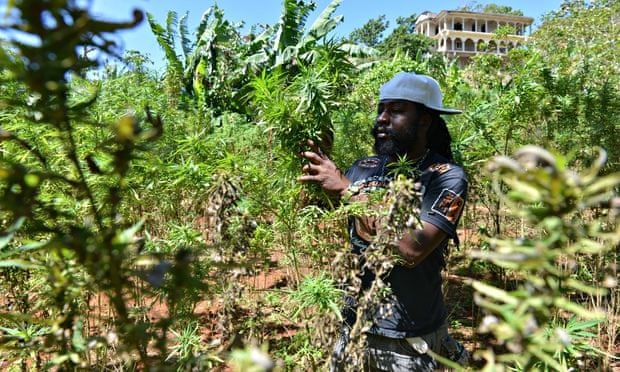
A cannabis farmer in Nine Mile, Jamaica. Photograph: David Mcfadden/AP
Jamaica poised to relax cannabis laws
Several restrictions on ‘ganja’ use could go up in smoke as island’s politicians back bill to establish licensing authority
The Jamaican cabinet has approved a bill that would decriminalise
possession of small amounts of cannabis and pave the way for a legal
medical marijuana industry, the justice minister has said.
Mark Golding said he expected to introduce the legislation in the Senate this week. Debate could start this month in the country where the drug, known popularly as “ganja”, has long been culturally entrenched but illegal.
The bill would establish a cannabis licensing authority to deal with the regulations needed to cultivate, sell and distribute the herb for medical, scientific and therapeutic purposes. “We need to position ourselves to take advantage of the significant economic opportunities offered by this emerging industry,” he said.
It would make possession of 2 ounces (56g) or less an offence that would not result in a criminal record. Cultivation of five or fewer plants on any premises would be permitted. Rastafarians, who use marijuana as a sacrament, could also legally use it for religious purposes for the first time in Jamaica, where the spiritual movement was founded in the 1930s.
For decades, debate has raged on the Caribbean island over laws governing marijuana use. But now, with several countries and US states relaxing their laws on the herb, Jamaica is advancing reform plans.
Golding said the government would not soften its stance on drug trafficking and it intended to use a proportion of revenues from its licensing authority to support a public education campaign to discourage pot-smoking by young people and mitigate public health consequences.
The director of the national Cannabis Commercial and Medicinal Research Taskforce said he expected the bill to be passed soon in parliament, where Portia Simpson Miller’s governing party holds a 2-1 majority. “This development is long overdue,” Delano Seiveright said.
Mark Golding said he expected to introduce the legislation in the Senate this week. Debate could start this month in the country where the drug, known popularly as “ganja”, has long been culturally entrenched but illegal.
The bill would establish a cannabis licensing authority to deal with the regulations needed to cultivate, sell and distribute the herb for medical, scientific and therapeutic purposes. “We need to position ourselves to take advantage of the significant economic opportunities offered by this emerging industry,” he said.
It would make possession of 2 ounces (56g) or less an offence that would not result in a criminal record. Cultivation of five or fewer plants on any premises would be permitted. Rastafarians, who use marijuana as a sacrament, could also legally use it for religious purposes for the first time in Jamaica, where the spiritual movement was founded in the 1930s.
For decades, debate has raged on the Caribbean island over laws governing marijuana use. But now, with several countries and US states relaxing their laws on the herb, Jamaica is advancing reform plans.
Golding said the government would not soften its stance on drug trafficking and it intended to use a proportion of revenues from its licensing authority to support a public education campaign to discourage pot-smoking by young people and mitigate public health consequences.
The director of the national Cannabis Commercial and Medicinal Research Taskforce said he expected the bill to be passed soon in parliament, where Portia Simpson Miller’s governing party holds a 2-1 majority. “This development is long overdue,” Delano Seiveright said.
http://www.theguardian.com/world/2015/jan/22/jamaica-considers-cannabis-legalisation
A cannabis farmer in Nine Mile, Jamaica. Photograph: David Mcfadden/AP
Science Wakes Up To Positive Aspects Of Psychedelic Mushrooms
Give science time - you never know when science will recognize the positive aspects of something that has been in use by people for centuries, even millennia.
From The Washington Post -
Psychedelic mushrooms can do more than make you see the world in kaleidoscope. Research suggests they may have permanent, positive effects on the human brain.
In fact, a mind-altering compound found in some 200 species of mushroom is already being explored as a potential treatment for depression and anxiety. People who consume these mushrooms, after "trips" that can be a bit scary and unpleasant, report feeling more optimistic, less self-centered, and even happier for months after the fact.
But why do these trips change the way people see the world? According to a study published today in Human Brain Mapping, the mushroom compounds could be unlocking brain states usually only experienced when we dream, changes in activity that could help unlock permanent shifts in perspective.
The study examined brain activity in those who’d received injections of psilocybin, which gives "shrooms" their psychedelic punch. Despite a long history of mushroom use in spiritual practice, scientists have only recently begun to examine the brain activity of those using the compound, and this is the first study to attempt to relate the behavioral effects to biological changes.
After injections, the 15 participants were found to have increased brain function in areas associated with emotion and memory. The effect was strikingly similar to a brain in dream sleep, according to Dr. Robin Carhart-Harris, a post-doctoral researcher in neuropsychopharmacology at Imperial College London and co-author of the study.
“You’re seeing these areas getting louder, and more active,” he said. “It’s like someone’s turned up the volume there, in these regions that are considered part of an emotional system in the brain. When you look at a brain during dream sleep, you see the same hyperactive emotion centers.”
In fact, administration of the drug just before or during sleep seemed to promote higher activity levels during Rapid Eye Movement sleep, when dreams occur. An intriguing finding, Carhart-Harris says, given that people tend to describe their experience on psychedelic drugs as being like “a waking dream.” It seems that the brain may literally be slipping into unconscious patterns while the user is awake.
Conversely, the subjects of the study had decreased activity in other parts of the brain—areas associated with high level cognition. “These are the most recent parts of our brain, in an evolutionary sense,” Carhart-Harris said. “And we see them getting quieter and less organized.”
This dampening of one area and amplification of another could explain the “mind-broadening” sensation of psychedelic drugs, he said. Unlike most recreational drugs, psychotropic mushrooms and LSD don’t provide a pleasant, hedonistic reward when they’re consumed. Instead, users take them very occasionally, chasing the strange neurological effects instead of any sort of high.
“Except for some naïve users who go looking for a good time…which, by the way, is not how it plays out,” Carhart-Harris said, “you see people taking them to experience some kind of mental exploration, and to try to understand themselves.”
Our firm sense of self—the habits and experiences that we find integral to our personality—is quieted by these trips. Carhart-Harris believes that the drugs may unlock emotion while “basically killing the ego,” allowing users to be less narrow-minded and let go of negative outlooks.
It’s still not clear why such effects can have more profound long-term effects on the brain than our nightly dreams. But Carhart-Harris hopes to see more of these compounds in modern medicine. “The way we treat psychological illnesses now is to dampen things,” he said. “We dampen anxiety, dampen ones emotional range in the hope of curing depression, taking the sting out of what one feels.”
But some patients seem to benefit from having their emotions “unlocked” instead. “It would really suit the style of psychotherapy where we engage in a patient’s history and hang-ups,” Carhart-Harris said. “Instead of putting a bandage over the exposed wound, we’d be essentially loosening their minds—promoting a permanent change in outlook.”
http://www.washingtonpost.com/news/to-your-health/wp/2014/07/03/psychedelic-drugs-put-your-brain-in-a-waking-dream-study-finds/?hpid=z6
 Lightworkerpeace/Wikimedia Commons Psilocybe Pelliculosa mushrooms, one of the more than 200 psilocybin-containing species.
"The brain does not simply become a random system after psilocybin injection," the researchers wrote, "but instead retains some organizational features, albeit different from the normal state."
http://finance.yahoo.com/news/tripping-mushrooms-changes-brain-204500998.html
From The Washington Post -
Psychedelic mushrooms put your brain in a “waking dream,” study finds
Psychedelic mushrooms can do more than make you see the world in kaleidoscope. Research suggests they may have permanent, positive effects on the human brain.
In fact, a mind-altering compound found in some 200 species of mushroom is already being explored as a potential treatment for depression and anxiety. People who consume these mushrooms, after "trips" that can be a bit scary and unpleasant, report feeling more optimistic, less self-centered, and even happier for months after the fact.
But why do these trips change the way people see the world? According to a study published today in Human Brain Mapping, the mushroom compounds could be unlocking brain states usually only experienced when we dream, changes in activity that could help unlock permanent shifts in perspective.
The study examined brain activity in those who’d received injections of psilocybin, which gives "shrooms" their psychedelic punch. Despite a long history of mushroom use in spiritual practice, scientists have only recently begun to examine the brain activity of those using the compound, and this is the first study to attempt to relate the behavioral effects to biological changes.
After injections, the 15 participants were found to have increased brain function in areas associated with emotion and memory. The effect was strikingly similar to a brain in dream sleep, according to Dr. Robin Carhart-Harris, a post-doctoral researcher in neuropsychopharmacology at Imperial College London and co-author of the study.
“You’re seeing these areas getting louder, and more active,” he said. “It’s like someone’s turned up the volume there, in these regions that are considered part of an emotional system in the brain. When you look at a brain during dream sleep, you see the same hyperactive emotion centers.”
In fact, administration of the drug just before or during sleep seemed to promote higher activity levels during Rapid Eye Movement sleep, when dreams occur. An intriguing finding, Carhart-Harris says, given that people tend to describe their experience on psychedelic drugs as being like “a waking dream.” It seems that the brain may literally be slipping into unconscious patterns while the user is awake.
Conversely, the subjects of the study had decreased activity in other parts of the brain—areas associated with high level cognition. “These are the most recent parts of our brain, in an evolutionary sense,” Carhart-Harris said. “And we see them getting quieter and less organized.”
This dampening of one area and amplification of another could explain the “mind-broadening” sensation of psychedelic drugs, he said. Unlike most recreational drugs, psychotropic mushrooms and LSD don’t provide a pleasant, hedonistic reward when they’re consumed. Instead, users take them very occasionally, chasing the strange neurological effects instead of any sort of high.
“Except for some naïve users who go looking for a good time…which, by the way, is not how it plays out,” Carhart-Harris said, “you see people taking them to experience some kind of mental exploration, and to try to understand themselves.”
Our firm sense of self—the habits and experiences that we find integral to our personality—is quieted by these trips. Carhart-Harris believes that the drugs may unlock emotion while “basically killing the ego,” allowing users to be less narrow-minded and let go of negative outlooks.
It’s still not clear why such effects can have more profound long-term effects on the brain than our nightly dreams. But Carhart-Harris hopes to see more of these compounds in modern medicine. “The way we treat psychological illnesses now is to dampen things,” he said. “We dampen anxiety, dampen ones emotional range in the hope of curing depression, taking the sting out of what one feels.”
But some patients seem to benefit from having their emotions “unlocked” instead. “It would really suit the style of psychotherapy where we engage in a patient’s history and hang-ups,” Carhart-Harris said. “Instead of putting a bandage over the exposed wound, we’d be essentially loosening their minds—promoting a permanent change in outlook.”
http://www.washingtonpost.com/news/to-your-health/wp/2014/07/03/psychedelic-drugs-put-your-brain-in-a-waking-dream-study-finds/?hpid=z6
From Yahoo.com -
How Tripping On Mushrooms Changes The Brain
By Erin Brodwin October 29, 2014 4:45 PM
Tripping on magic mushrooms may
actually free the mind, a new study says. The compounds in the
(illegal) mushrooms change the way the brain works.
New research suggests that psilocybin, the main psychoactive ingredient in magic mushrooms, sprouts new links across previously disconnected brain regions, temporarily altering the brain's entire organizational framework.
These new connections are likely
what allow users to experience things like seeing sounds or hearing
colors. And they could also be responsible for giving magic mushrooms
some of their antidepressant qualities.
When researchers compared the
brains of people who had received IV injections of psilocybin with those
of people given a placebo, they found that the drug changed how
information was carried across the brain. (Subjects received 2
milligrams of psilocybin; the dose and concentration of the chemical in
actual mushrooms — which are eaten, not injected — varies.) Typically,
brain activity follows specific neural networks. But in the people given
psilocybin injections, cross-brain activity seemed more erratic, as if
freed from its normal framework.
When the researchers looked more
closely, however, they noticed that the sparks of activity across the
brains of their drugged volunteers wasn't as chaotic as it seemed.
Instead, the activity formed distinct patterns, or cycles."The brain does not simply become a random system after psilocybin injection," the researchers wrote, "but instead retains some organizational features, albeit different from the normal state."
Picture the information in your
brain being shared across an interconnected and heavily-trafficked
system of highways. In that example, psilocybin isn't removing the
highways. Instead, it's simply building new ones.
These new connections
allow parts of the brain that don't usually talk to one another to
communicate. People who use magic mushrooms and see the number 52 as
glowing bright blue and red, then, don't see it that way because the
drugs have made them crazy. Instead, they associate the number with
colors because the brain region that detects and interprets color has
been chatting it up with the brain region that processes numbers.
This new insight into what
psilocybin does to the brain could help explain years of earlier
findings on psilocybin's psychological effects, including how magic
mushrooms seem to curb symptoms of depression.
In a 2012 study, Imperial College London neuroscientist David Nutt found that in people drugged with psilocybin, brain chatter across traditional areas of the brain was muted,
including in a region thought to play a role in maintaining our sense
of self. In depressed people, Nutt believes, the connections between
brain circuits in this sense-of-self region are too strong. "People who
get into depressive thinking, their brains are overconnected," Nutt told Psychology Today. Negative thoughts and feelings of self-criticism become obsessive and overwhelming.
Loosening those connections and creating new ones, Nutt thinks, could provide intense relief.
Johns Hopkins psychologists came to similar findings when they induced out of body experiences
in a small group of volunteers dosed with psilocybin. Immediately
following their sessions, participants said they felt more open, more
imaginative, and more appreciative of beauty. When the researchers
followed up with the volunteers a year later, nearly two-thirds said the
experience had been one of the most important in their lives; close to
half continued to score higher on a personality test of openness than
they had before taking the drug.
Nick Fernandez, a former cancer patient and psychology graduate
student who took psilocybin as part of a New York University study,
experienced those same feelings of freedom and positivity.
"For the first time in my life, I felt like there was... a force greater than myself," Fernandez told Aeon Magazine.
"Something inside me snapped and I experienced a... shift that made me
realize all my anxieties, defenses, and insecurities weren't something
to worry about."
http://finance.yahoo.com/news/tripping-mushrooms-changes-brain-204500998.html
Thursday, January 15, 2015
Asset Forfeiture Is A Police Scam
When the people who ran the program tell you the program is defective......... maybe believe them! The Washington Post ran a series on how asset seizing is abused by police. This is an editorial after the series ran by two men who helped run the Federal asset seizure program. The idea that they call this "forfeiture" is ludicrous - it is seizure not any forfeiture. What kind of forfeiture is it when a gun is held to your head?
To add insult to injury, police departments actually budget in advance based on expected seizures. In other words, if they don't keep pace on seizures, some police programs and/or purchases would have to be cut. Sounds like pretty good motivation to seize whatever you can.
John Yoder was director of the Justice Department’s Asset Forfeiture Office from 1983 to 1985. Brad Cates was the director of the office from 1985 to 1989.
http://www.washingtonpost.com/opinions/abolish-the-civil-asset-forfeiture-program-we-helped-create/2014/09/18/72f089ac-3d02-11e4-b0ea-8141703bbf6f_story.html?hpid=z7
To add insult to injury, police departments actually budget in advance based on expected seizures. In other words, if they don't keep pace on seizures, some police programs and/or purchases would have to be cut. Sounds like pretty good motivation to seize whatever you can.
Government self-interest corrupted a crime-fighting tool into an evil
John Yoder was director of the Justice Department’s Asset Forfeiture Office from 1983 to 1985. Brad Cates was the director of the office from 1985 to 1989.
Last week, The Post published a series
of in-depth articles about the abuses spawned by the law enforcement
practice known as civil asset forfeiture. As two people who were heavily
involved in the creation of the asset forfeiture initiative at the
Justice Department in the 1980s, we find it particularly painful to
watch as the heavy hand of government goes amok. The program began with
good intentions but now, having failed in both purpose and execution, it
should be abolished.
Asset forfeiture was
conceived as a way to cut into the profit motive that fueled rampant
drug trafficking by cartels and other criminal enterprises, in order to
fight the social evils of drug dealing and abuse. Over time, however,
the tactic has turned into an evil itself, with the corruption it
engendered among government and law enforcement coming to clearly
outweigh any benefits.
The idea seemed so
simple: Seize the ill-gotten gains of big-time drug dealers and remove
the financial incentive for their criminality. After all, if a kingpin
could earn $20 million and stash it away somewhere, even a decade in
prison would have its rewards. Make that money disappear, and the
calculus changes.
Then, in 1986, the
concept was expanded to include not only cash earned illegally but also
purchases or investments made with that money, creating a whole scheme
of new crimes that could be prosecuted as “money laundering.”
The property eligible for seizure was further expanded to include
“instrumentalities” in the trafficking of drugs, such as cars or even
jewelry. Eventually, more than 200 crimes beyond drugs came to be
included in the forfeiture scheme.
This
all may have been fine in theory, but in the real world it went badly
astray. First, many states adopted their own forfeiture laws, creating
programs with less monitoring than those at the federal level. Second,
state law enforcement agencies and prosecutors started using the
property — and finally even to provide basic funding for their
departments.
Even at the outset, the use of seized property
was an issue. Drug Enforcement Administration agents, for example, might
see a suspected dealer in a car they wanted for undercover work and
seize it. But if the car had an outstanding loan, the DEA could not keep
it without paying the lien. This led to distorted enforcement
decisions, with agents choosing whom to pursue based on irrelevant
factors such as whether the target owed money on his car.
As
time went on and states got into the forfeiture game, the uses became
more personally rewarding for law enforcement. Maintaining an undercover
identity was often no longer even part of the justification for
seizures.
Law enforcement agents and
prosecutors began using seized cash and property to fund their
operations, supplanting general tax revenue, and this led to the most
extreme abuses: law enforcement efforts based upon what cash and
property they could seize to fund themselves, rather than on an
even-handed effort to enforce the law.
Many
Americans are familiar with old-time speed traps, which became so
notorious that most state legislatures reformed their systems to require
local police and courts to deposit traffic fines into the state
treasury to avoid the appearance of biased justice. Today, the old speed
traps have all too often been replaced by forfeiture traps, where local
police stop cars and seize cash and property to pay for local law
enforcement efforts. This is a complete corruption of the process, and
it unsurprisingly has led to widespread abuses.
The Asset Forfeiture Reform Act
was enacted in 2000 to rein in abuses, but virtually nothing has
changed. This is because civil forfeiture is fundamentally at odds with
our judicial system and notions of fairness. It is unreformable.
In
America, it is often said that it is better that nine guilty people go
free than one innocent person be wrongly convicted. But our forfeiture
laws turn our traditional concept of guilt upside down. Civil forfeiture
laws presume someone’s personal property to be tainted, placing the
burden of proving it “innocent” on the owner. What of the Fourth Amendment requirement that a warrant to seize or search requires the showing of probable cause of a specific violation?
Defendants should be charged with the crimes
they commit. Charge someone with drug dealing if it can be proved, but
don’t invent a second offense of “money laundering” to use as a backup
or a pretext to seize cash. Valid, time-tested methods exist to allow
law enforcement to seize contraband, profits and instrumentalities via
legitimate criminal prosecution.
Civil
asset forfeiture and money-laundering laws are gross perversions of the
status of government amid a free citizenry. The individual is the font
of sovereignty in our constitutional republic, and it is unacceptable
that a citizen should have to “prove” anything to the government. If the
government has probable cause of a violation of law, then let a warrant
be issued. And if the government has proof beyond a reasonable doubt of
guilt, let that guilt be proclaimed by 12 peers.
http://www.washingtonpost.com/opinions/abolish-the-civil-asset-forfeiture-program-we-helped-create/2014/09/18/72f089ac-3d02-11e4-b0ea-8141703bbf6f_story.html?hpid=z7
Lebanese Politician Calls For Legal Marijuana
Of note is the report that Walid Jumblatt, a veteran Lebanese politician is now calling for legal marijuana.
Lebanese Marijuana Farmers Record Bumper Crop, As Syrian Civil War Occupies Authorities

A marijuana farmer in Lebanon's Bekaa valley.
Getty Images
Marijuana farmers in Lebanon claim that with authorities
distracted by the fallout from the civil war in neighboring Syria, they
have been able to reap bumper harvests of the drug.
Previously, the Lebanese army would burn fields of the drug
grown to be exported and sold on the streets of Europe, but with the
unrest in Syria causing thousands to flee into Lebanon leaving the
army's hands full, farmers have been free to cultivate the crop.
"This year we had a good year," Ali Nasri Shamas, a local marijuana kingpin told the Telegraph.
He said that farmers had stockpiled weapons, and would defend their crop from authorities.
"We are selling hashish, and if anyone from the government tries to come close to it, we'll kill them."
Swaths of agricultural land in the country which were once
used to cultivate beet crops have been turned over to marijuana
production, with Shamas buying the produce of small-scale farmers, as
well as employing his own growers, and processing the crop in a secret
plant in the Bekaa valley.
Shamas said that after being made into hashish, it is
exported to nearby countries, including Egypt and Syria, with the war
having loosened Syrian border controls. But some is sold to European
suppliers, including retailers in Amsterdam, where the drug is legal,
and the U.K.
He said that there was now such an abundant supply of the
drug that prices had fallen, and that farmers would pocket $1,200 two
years ago, but now taking only a quarter of that: $350.
However, he said that his main farmers still stood to make around half a million dollars a year.
Lebanon became a hub for the production of drugs during its
1975-1990 civil war, and Shamas said that subsequent political
corruption and failed attempts to replace marijuana with other crops had
left the region impoverished.
This week, Walid Jumblatt, a prominent politician from the
country's Druze minority, called for the cultivation of the drug to be
legalized.
"It's time to allow hash to be grown and to overturn arrest
warrants against people sought for doing so," the veteran politician
wrote in Arabic on his Twitter account, reports AFP.
http://www.ibtimes.com/lebanese-marijuana-farmers-record-bumper-crop-syrian-civil-war-occupies-authorities-1764156
Accountability: Does It Apply To The Police?
Police often think what is good for them is not for everyone else. Ever take pictures of the police? They don't like it is my general impression based on police response when I have taken pictures of police doing or not doing their job.
by Chris Matyszczyk
Surveillance is for our own good.
By having everything that we are doing monitored, we can be sure that we (who have nothing to hide) will be safe.
At least, that's the logic many authorities offer us, as they spy, pry, and vilify anyone who might feel suspicious.
What happens, though, when you suspect the authorities of behaving suspiciously? Is it all right to spy on them?
Miami Gardens, Fla., convenience store owner Alex Saleh decided he'd try. He'd become vexed at what he saw as police harassment of his employees and even his customers.
So he installed surveillance cameras, with the specific intention of watching the detectives.
He'd become frustrated, you see, about the possibly not coincidental number of times that his employee, Earl Sampson, had been stopped and questioned by police officers -- 258 times over a four-year period does seem a little like overkill. These included 100 searches and 56 jailings. As for convictions, well, they were only for marijuana possession.
Saleh told the Miami Herald it seemed odd that Sampson had been arrested 62 times for trespassing, when the vast majority of offenses were outside the very same Quickstop.
That would be the Quickstop where Sampson worked.
In all, Saleh installed 15 surveillance cameras. Some might find a certain poetry in the fact that he felt the need for them, when he says his store has never been robbed.
The videos make for numbing viewing. In one, a store employee takes out the trash, only to be arrested for trespassing. Others appear to show searches without warrants and police stopping customers without any obvious reason.
Miami Gardens is neither an easy, nor a safe place. But the police's reluctance to so far comment on these videos and the Herald's reporting suggest that some questions might need to be answered.
Clearly, there is a history between Saleh and the police. He filed an internal affairs report against some officers. He claims they retaliated by being more aggressive.
But he's owned the store for 17 years. The fact that he has to install cameras in an attempt to prove what he feels is racial profiling, excessive aggression, and intimidation might be a portent of what is to come, as technology becomes ever more involved in everyday life.
If police officers are to be outfitted with cameras , will citizens feel the need to have Google Glass or its equivalent, just to ensure they have their own filmic version of an encounter with authorities?
Some police officers have aggressively shown how uncomfortable they are with ordinary citizens filming them in the line of duty.
In one case this year, police in Bakersfield, Calif., were accused of erasing cell phone video of an incident in which a man died.
In another incident in San Diego, an officer being filmed making an arrest declared that the Samsung Galaxy in question was a weapon .
Even if we're all filming each other, there will still be questions surrounding editing and other forms of manipulation.
In the search for justice, there's always that nagging question: Whose?
http://www.cnet.com/news/store-owner-installs-surveillance-cameras-to-spy-on-police/#ftag=YHF65cbda0
Store owner installs surveillance cameras to spy on police
A Miami
convenience store owner is fed up with his employees and customers being
allegedly harassed by police. So he installs surveillance video to get
evidence against the local cops.
by Chris Matyszczyk
Surveillance is for our own good.
By having everything that we are doing monitored, we can be sure that we (who have nothing to hide) will be safe.
At least, that's the logic many authorities offer us, as they spy, pry, and vilify anyone who might feel suspicious.
What happens, though, when you suspect the authorities of behaving suspiciously? Is it all right to spy on them?
Miami Gardens, Fla., convenience store owner Alex Saleh decided he'd try. He'd become vexed at what he saw as police harassment of his employees and even his customers.
So he installed surveillance cameras, with the specific intention of watching the detectives.
He'd become frustrated, you see, about the possibly not coincidental number of times that his employee, Earl Sampson, had been stopped and questioned by police officers -- 258 times over a four-year period does seem a little like overkill. These included 100 searches and 56 jailings. As for convictions, well, they were only for marijuana possession.
Saleh told the Miami Herald it seemed odd that Sampson had been arrested 62 times for trespassing, when the vast majority of offenses were outside the very same Quickstop.
That would be the Quickstop where Sampson worked.
In all, Saleh installed 15 surveillance cameras. Some might find a certain poetry in the fact that he felt the need for them, when he says his store has never been robbed.
The videos make for numbing viewing. In one, a store employee takes out the trash, only to be arrested for trespassing. Others appear to show searches without warrants and police stopping customers without any obvious reason.
Miami Gardens is neither an easy, nor a safe place. But the police's reluctance to so far comment on these videos and the Herald's reporting suggest that some questions might need to be answered.
Clearly, there is a history between Saleh and the police. He filed an internal affairs report against some officers. He claims they retaliated by being more aggressive.
But he's owned the store for 17 years. The fact that he has to install cameras in an attempt to prove what he feels is racial profiling, excessive aggression, and intimidation might be a portent of what is to come, as technology becomes ever more involved in everyday life.
If police officers are to be outfitted with cameras , will citizens feel the need to have Google Glass or its equivalent, just to ensure they have their own filmic version of an encounter with authorities?
Some police officers have aggressively shown how uncomfortable they are with ordinary citizens filming them in the line of duty.
In one case this year, police in Bakersfield, Calif., were accused of erasing cell phone video of an incident in which a man died.
In another incident in San Diego, an officer being filmed making an arrest declared that the Samsung Galaxy in question was a weapon .
Even if we're all filming each other, there will still be questions surrounding editing and other forms of manipulation.
In the search for justice, there's always that nagging question: Whose?
http://www.cnet.com/news/store-owner-installs-surveillance-cameras-to-spy-on-police/#ftag=YHF65cbda0
Friday, January 2, 2015
Wendell Berry - Dose of Reality
I have been reading Wendell Berry since the late 1970's. More people need to listen to him. A poet and a farmer - or a farmer and a poet.
From The Guardian -
Roger Cohn for Yale Environment 360, part of the Guardian Environment Network
Thursday 6 March 2014

Author Wendell Berry at his home in Port Royal, Kentucky. Photograph: Ed Reinke/ASSOCIATED PRESS
From The Guardian -
Wendell Berry: 'for Americans to talk about sustainability is a bit of a joke'
Roger Cohn for Yale Environment 360, part of the Guardian Environment Network
Thursday 6 March 2014
Author Wendell Berry at his home in Port Royal, Kentucky. Photograph: Ed Reinke/ASSOCIATED PRESS
Wendell Berry wrote about and practiced “sustainable agriculture” long before the term was widely used. His 1977 book, The Unsettling of America: Culture and Agriculture,
in which he argued against industrial agriculture and for small-scale,
local-based farming, had a strong influence on the environmental and
local food movements in the US.
Berry has long balanced the diverse roles of writer, activist, teacher, and farmer. At age 79, he still lives on the farm near Port Royal, Kentucky, where he grew up, and uses traditional methods to work the land there. And he still speaks eloquently about the importance of local communities and of caring for the land, while warning of the destructive potential of industrialization and technology.
In an interview with Yale Environment 360 editor Roger Cohn, Berry talked about his Kentucky farm and why he has remained there, why he would risk arrest to protest mountaintop removal mining, why the sustainable agriculture movement faces an uphill battle, and why strong rural communities are important. “A deep familiarity between a local community and a local landscape is a dear thing, just in human terms,” Berry said. “It’s also, down the line, money in the bank, because it helps you to preserve the working capital of the place.”
Yale Environment 360: You’ve been writing about and practicing what is now known as sustainable agriculture since before that term was widely used. In recent years, there’s been a movement among some people toward sustainable agriculture. Do you feel sustainable agriculture is gaining ground in a significant way that could slow the growth of industrial agriculture, or is it more of a boutique type of thing?
Wendell Berry: Well, we are a young country. By the time settlement reached Kentucky it was 1775, and the industrial revolution was already underway. So we’ve been 238 years in Kentucky, we Old World people. And what we have done there in that time has not been sustainable. In fact, it has been the opposite. There’s less now of everything in the way of natural gifts, less of everything than what was there when we came. Sometimes we have radically reduced the original gift. And so for Americans to talk about sustainability is a bit of a joke, because we haven’t sustained anything very long — and a lot of things we haven’t sustained at all.
The acreage that is now under the influence of the local food effort or the sustainable agriculture effort is at present tiny, and industrial agriculture is blasting ahead at a great rate. For instance, in the last two years, the high price of corn and soybeans has driven that kind of agriculture into the highly vulnerable uplands of my home country. I can show you farms that in my lifetime have been mostly in grass that are now suddenly covered, line fence to line fence, with monocultures of corn or beans….
So we have these two things, a promising start on what we call, loosely, sustainable land use, and we have a still far larger industrial extractive agriculture operating, really, against the land.
e360: On your place where you live now and farm, what are some of the practices that you employ and use to take good care of the land and make it sustainable?
Berry: The farm that my wife and I have is in every way marginal. Every foot of it is either steep, which is most of it, or it floods [Laughs]. So it’s land that you can learn a lot from in a hurry because it is so demanding of care. The way to deal with that land is to keep it covered with permanent pasture or woodland. We have some slopes in pasture that ought to have remained woodland, but we’ve kept most of it going the way it came to us.
e360: And do you do forest logging there as well?
Berry: Most of our woodland we don’t use, but some we use for firewood, an occasional saw log, fence posts, that sort of thing. The emerald ash borer [a destructive beetle] is now among us, and we are cutting the large trees that the emerald ash borer has killed. The ash wood is valuable as sawed lumber, and it’s also wonderful firewood… My son does woodworking, and so it’s worthwhile to him to have supplies of sawed boards laid up.
e360: You write a lot about local agriculture and the local economy, about local traditions and the importance of connections to the land. Why do you think this is so important?
Berry: That starts with the obvious perception that land that is in human use requires human care. And this calls for keeping in mind the history of such land, of what has worked well on it and the mistakes that have been made on it. To lose this living memory of what has happened to the place is really to lose an economic asset.
I’m more and more concerned with the economic values of such intangibles as affection, knowledge, and memory. A deep familiarity between a local community and the local landscape is a dear thing, just in human terms. It’s also, down the line, money in the bank because it helps you to preserve the working capital of the place.
e360: You along with Wes Jackson of the Land Institute have proposed a 50-year farm bill. Can you explain what that is and how it would differ from typical US farm bills?
Berry: Unlike the typical US farm bill, the 50-Year Farm Bill attempts to address the real and ongoing problems of agriculture: erosion, toxicity, loss of genetic and species diversity, and the destruction of rural communities, or the destruction, where it still survives, of the culture of husbandry. It begins with the fact that at present, 80% of the land is planted annually in annual crops such as corn and beans, and 20% in perennials. It proposes a 50-year program for the gradual inversion of that ratio to 80% perennial cover and 20% annuals. It’s pretty clear that annual plants are nature’s emergency service. They’re the plants that come in after, say, a landslide, after the land has been exposed, and they give it a temporary cover while the perennials are getting started. So our predominantly annual agriculture keeps the land in a state of emergency.
It’s hard to make a permanent agriculture on the basis of an emergency strategy. By now the planted acreages have grown so large that most soybean and corn fields, for instance, are not seeded to cover crops, and so they lie exposed to the weather all winter. You can drive through Iowa in April before the new crops have been planted and started to grow, and you don’t see anything green mile after mile. It’s more deserted than a desert. And the soil erosion rates in Iowa are scandalous.
e360: I know you’ve had people tell you that your writing has inspired them to think about chucking their jobs and their city life and go farm. What do you tell them?
Berry: Well, I try to recommend caution. You don’t want somebody who’s 45 or 50 years old, who doesn’t know anything about farming, to throw up his or her present life and undertake to make a living from farming at a time when farmers, experienced farmers, are failing and going out of business. So characteristically I’ve said, “If you do this, keep your town job. If you’re not independently wealthy, you’ve got to have a dependable income from somewhere off the farm.” And I’ve tried to stress the difference between depending on the weather, on nature, for an income and depending on a salary. There’s a very wide gulf between those two kinds of dependence.
e360: Three years ago you participated in a sit-in at the governor’s office in Kentucky over the issue of mountaintop removal mining. What was that like, and why did you get involved with it in the first place?
Berry: I got involved because I was tired of talking. I saw that we were going to Frankfort [the state capital] every year and trying to talk to senators and representatives in the General Assembly, and to the governor if we could.Their very understandable impulse was to get rid of us as quickly as possible and have us leave feeling good… There are two parties in Kentucky — the party of coal and the party of everything else. Both the Democratic politicians and the Republican politicians, mostly, in most areas of the state, have to pay homage to coal, to even think about running for office.
So it was clear that talking wasn’t going to do any good. I don’t think what we wound up doing did any good either, but we had to raise the stakes somehow. And so we did go to Frankfort, confront the governor, and we had a list of requests that he would have to grant or he would not get rid of us. And he pulled a pretty smart trick on us. He invited us to spend the weekend. For obvious reasons, he didn’t want pictures in the paper of these innocent people being led off in handcuffs, and he said “Just stay, be my guests.” He outsmarted us. But he couldn’t neutralize us — the circumstance that he put us in really gave us a lot of visibility, a lot of contact with the press, and attracted a lot of sympathy.
e360: Do you think any positive developments have occurred since then?
Berry: No. I think we’ve got to keep up our opposition to land abuse and we’ve got to continue to communicate what that’s all about and what it signifies. What it signifies is that some people are willing to go the limit in earth destruction, to put it entirely at risk and destroy it entirely to preserve “our way of life.” A lot of people are willing to tolerate that.
Mountaintop removal is as near total destruction as you can imagine, because it does away with the forest, it does away with the topsoil that sustained the forest, it does away with the very topography — even people’s family graveyards go. And it’s done in complete disregard not only of the land but of the people who live downhill, whose lives are threatened, whose water supplies are destroyed, whose homes are damaged. The people downhill, downstream, and ahead of us in time are totally disregarded.
e360: As someone who’s followed your writing over the years, it seems to me that in some ways you’ve become more radical in your thinking, unlike a lot of people who as they get older tend to become more conservative. Do you think that’s true, and if so, why?
Berry: It’s true. One reason is that as I’ve grown older I’ve understood more clearly the difficulties that we’re in, the bad fix that we’re in and that we’re leaving to our children. And as I’ve grown older I’ve understood that when I put my comfort on the line as a protester or whatever, I’m doing what old people ought to do. I have less life to live than the young people. I think the old people ought to be the first ones in line to risk arrest.
e360: I’ve heard you describing the difference between optimism and hope, and you said that in terms of the issues you really care about, you would not describe yourself as optimistic but as hopeful. Can you explain that?
Berry: The issue of hope is complex and the sources of hope are complex. The things hoped for tend to be specific and to imply an agenda of work, things that can be done. Optimism is a general program that suggests that things are going to come out swell, pretty much whether we help out or not. This is largely unjustified by circumstances and history. One of the things that I think people on my side of these issues are always worried about is the ready availability of cynicism, despair, nihilism — those things that really are luxuries that permit people to give up, relax about the problems. Relax and let them happen. Another thing that can bring that about is so-called objectivity — the idea that this way might be right but on the other hand the opposite way might be right. We find this among academic people pretty frequently — the idea that you don’t take a stand, you just talk about the various possibilities.
But our side requires commitment, it requires effort, it requires a continual effort to define and understand what is possible — not only what is desirable, but what is possible in the immediate circumstances.
e360: You’ve had many opportunities over the years to leave Port Royal — you had teaching jobs at universities — but you made the decision to go back and stay there. Why?
Berry: Well because I love the place. Both my father and my mother came from the Port Royal neighborhood, and I was one of the farm-raised young people who loved both farming and the place. Port Royal is what a lot of people have been schooled to call “nowhere.” I remember a college student who told me, “I’m from a little nowhere place in Illinois.” And I said, ”Wait a minute. I want to ask you something: Who told you that where you come from in Illinois is nowhere? There is no such place as nowhere.” We’ve dumped our garbage in our places, we’ve polluted them and mistreated them in every way, because we thought they were nowhere. It’s extremely important, it seems to me, that those nowhere places should be inhabited by people who will speak for them.
e360: You’ve had four careers, really — writer, farmer, activist, and teacher. How do you see those parts of your life fitting together?
Berry: A question I’m often asked is, “How have you balanced these various pursuits?” And the word “balance” always implies that I have balanced them, and of course I haven’t. It’s been difficult and sometimes a struggle to keep it all going.
e360: Difficult in what way?
Berry: Well, to find time for it all. I’ve known writers — I think it’s true also of other artists — who thought that you had to put your art before everything. But if you have a marriage and a family and a farm, you’re just going to find that you can’t always put your art first, and moreover that you shouldn’t. There are a number of things more important than your art. It’s wrong to favor it over your family, or over your place, or over your animals.
• Roger Cohn is the editor of Yale Environment 360
http://www.theguardian.com/environment/2014/mar/06/wendell-berry-americans-sustainability-joke
Berry has long balanced the diverse roles of writer, activist, teacher, and farmer. At age 79, he still lives on the farm near Port Royal, Kentucky, where he grew up, and uses traditional methods to work the land there. And he still speaks eloquently about the importance of local communities and of caring for the land, while warning of the destructive potential of industrialization and technology.
In an interview with Yale Environment 360 editor Roger Cohn, Berry talked about his Kentucky farm and why he has remained there, why he would risk arrest to protest mountaintop removal mining, why the sustainable agriculture movement faces an uphill battle, and why strong rural communities are important. “A deep familiarity between a local community and a local landscape is a dear thing, just in human terms,” Berry said. “It’s also, down the line, money in the bank, because it helps you to preserve the working capital of the place.”
Yale Environment 360: You’ve been writing about and practicing what is now known as sustainable agriculture since before that term was widely used. In recent years, there’s been a movement among some people toward sustainable agriculture. Do you feel sustainable agriculture is gaining ground in a significant way that could slow the growth of industrial agriculture, or is it more of a boutique type of thing?
Wendell Berry: Well, we are a young country. By the time settlement reached Kentucky it was 1775, and the industrial revolution was already underway. So we’ve been 238 years in Kentucky, we Old World people. And what we have done there in that time has not been sustainable. In fact, it has been the opposite. There’s less now of everything in the way of natural gifts, less of everything than what was there when we came. Sometimes we have radically reduced the original gift. And so for Americans to talk about sustainability is a bit of a joke, because we haven’t sustained anything very long — and a lot of things we haven’t sustained at all.
The acreage that is now under the influence of the local food effort or the sustainable agriculture effort is at present tiny, and industrial agriculture is blasting ahead at a great rate. For instance, in the last two years, the high price of corn and soybeans has driven that kind of agriculture into the highly vulnerable uplands of my home country. I can show you farms that in my lifetime have been mostly in grass that are now suddenly covered, line fence to line fence, with monocultures of corn or beans….
So we have these two things, a promising start on what we call, loosely, sustainable land use, and we have a still far larger industrial extractive agriculture operating, really, against the land.
e360: On your place where you live now and farm, what are some of the practices that you employ and use to take good care of the land and make it sustainable?
Berry: The farm that my wife and I have is in every way marginal. Every foot of it is either steep, which is most of it, or it floods [Laughs]. So it’s land that you can learn a lot from in a hurry because it is so demanding of care. The way to deal with that land is to keep it covered with permanent pasture or woodland. We have some slopes in pasture that ought to have remained woodland, but we’ve kept most of it going the way it came to us.
e360: And do you do forest logging there as well?
Berry: Most of our woodland we don’t use, but some we use for firewood, an occasional saw log, fence posts, that sort of thing. The emerald ash borer [a destructive beetle] is now among us, and we are cutting the large trees that the emerald ash borer has killed. The ash wood is valuable as sawed lumber, and it’s also wonderful firewood… My son does woodworking, and so it’s worthwhile to him to have supplies of sawed boards laid up.
e360: You write a lot about local agriculture and the local economy, about local traditions and the importance of connections to the land. Why do you think this is so important?
Berry: That starts with the obvious perception that land that is in human use requires human care. And this calls for keeping in mind the history of such land, of what has worked well on it and the mistakes that have been made on it. To lose this living memory of what has happened to the place is really to lose an economic asset.
I’m more and more concerned with the economic values of such intangibles as affection, knowledge, and memory. A deep familiarity between a local community and the local landscape is a dear thing, just in human terms. It’s also, down the line, money in the bank because it helps you to preserve the working capital of the place.
e360: You along with Wes Jackson of the Land Institute have proposed a 50-year farm bill. Can you explain what that is and how it would differ from typical US farm bills?
Berry: Unlike the typical US farm bill, the 50-Year Farm Bill attempts to address the real and ongoing problems of agriculture: erosion, toxicity, loss of genetic and species diversity, and the destruction of rural communities, or the destruction, where it still survives, of the culture of husbandry. It begins with the fact that at present, 80% of the land is planted annually in annual crops such as corn and beans, and 20% in perennials. It proposes a 50-year program for the gradual inversion of that ratio to 80% perennial cover and 20% annuals. It’s pretty clear that annual plants are nature’s emergency service. They’re the plants that come in after, say, a landslide, after the land has been exposed, and they give it a temporary cover while the perennials are getting started. So our predominantly annual agriculture keeps the land in a state of emergency.
It’s hard to make a permanent agriculture on the basis of an emergency strategy. By now the planted acreages have grown so large that most soybean and corn fields, for instance, are not seeded to cover crops, and so they lie exposed to the weather all winter. You can drive through Iowa in April before the new crops have been planted and started to grow, and you don’t see anything green mile after mile. It’s more deserted than a desert. And the soil erosion rates in Iowa are scandalous.
e360: I know you’ve had people tell you that your writing has inspired them to think about chucking their jobs and their city life and go farm. What do you tell them?
Berry: Well, I try to recommend caution. You don’t want somebody who’s 45 or 50 years old, who doesn’t know anything about farming, to throw up his or her present life and undertake to make a living from farming at a time when farmers, experienced farmers, are failing and going out of business. So characteristically I’ve said, “If you do this, keep your town job. If you’re not independently wealthy, you’ve got to have a dependable income from somewhere off the farm.” And I’ve tried to stress the difference between depending on the weather, on nature, for an income and depending on a salary. There’s a very wide gulf between those two kinds of dependence.
e360: Three years ago you participated in a sit-in at the governor’s office in Kentucky over the issue of mountaintop removal mining. What was that like, and why did you get involved with it in the first place?
Berry: I got involved because I was tired of talking. I saw that we were going to Frankfort [the state capital] every year and trying to talk to senators and representatives in the General Assembly, and to the governor if we could.Their very understandable impulse was to get rid of us as quickly as possible and have us leave feeling good… There are two parties in Kentucky — the party of coal and the party of everything else. Both the Democratic politicians and the Republican politicians, mostly, in most areas of the state, have to pay homage to coal, to even think about running for office.
So it was clear that talking wasn’t going to do any good. I don’t think what we wound up doing did any good either, but we had to raise the stakes somehow. And so we did go to Frankfort, confront the governor, and we had a list of requests that he would have to grant or he would not get rid of us. And he pulled a pretty smart trick on us. He invited us to spend the weekend. For obvious reasons, he didn’t want pictures in the paper of these innocent people being led off in handcuffs, and he said “Just stay, be my guests.” He outsmarted us. But he couldn’t neutralize us — the circumstance that he put us in really gave us a lot of visibility, a lot of contact with the press, and attracted a lot of sympathy.
e360: Do you think any positive developments have occurred since then?
Berry: No. I think we’ve got to keep up our opposition to land abuse and we’ve got to continue to communicate what that’s all about and what it signifies. What it signifies is that some people are willing to go the limit in earth destruction, to put it entirely at risk and destroy it entirely to preserve “our way of life.” A lot of people are willing to tolerate that.
Mountaintop removal is as near total destruction as you can imagine, because it does away with the forest, it does away with the topsoil that sustained the forest, it does away with the very topography — even people’s family graveyards go. And it’s done in complete disregard not only of the land but of the people who live downhill, whose lives are threatened, whose water supplies are destroyed, whose homes are damaged. The people downhill, downstream, and ahead of us in time are totally disregarded.
e360: As someone who’s followed your writing over the years, it seems to me that in some ways you’ve become more radical in your thinking, unlike a lot of people who as they get older tend to become more conservative. Do you think that’s true, and if so, why?
Berry: It’s true. One reason is that as I’ve grown older I’ve understood more clearly the difficulties that we’re in, the bad fix that we’re in and that we’re leaving to our children. And as I’ve grown older I’ve understood that when I put my comfort on the line as a protester or whatever, I’m doing what old people ought to do. I have less life to live than the young people. I think the old people ought to be the first ones in line to risk arrest.
e360: I’ve heard you describing the difference between optimism and hope, and you said that in terms of the issues you really care about, you would not describe yourself as optimistic but as hopeful. Can you explain that?
Berry: The issue of hope is complex and the sources of hope are complex. The things hoped for tend to be specific and to imply an agenda of work, things that can be done. Optimism is a general program that suggests that things are going to come out swell, pretty much whether we help out or not. This is largely unjustified by circumstances and history. One of the things that I think people on my side of these issues are always worried about is the ready availability of cynicism, despair, nihilism — those things that really are luxuries that permit people to give up, relax about the problems. Relax and let them happen. Another thing that can bring that about is so-called objectivity — the idea that this way might be right but on the other hand the opposite way might be right. We find this among academic people pretty frequently — the idea that you don’t take a stand, you just talk about the various possibilities.
But our side requires commitment, it requires effort, it requires a continual effort to define and understand what is possible — not only what is desirable, but what is possible in the immediate circumstances.
e360: You’ve had many opportunities over the years to leave Port Royal — you had teaching jobs at universities — but you made the decision to go back and stay there. Why?
Berry: Well because I love the place. Both my father and my mother came from the Port Royal neighborhood, and I was one of the farm-raised young people who loved both farming and the place. Port Royal is what a lot of people have been schooled to call “nowhere.” I remember a college student who told me, “I’m from a little nowhere place in Illinois.” And I said, ”Wait a minute. I want to ask you something: Who told you that where you come from in Illinois is nowhere? There is no such place as nowhere.” We’ve dumped our garbage in our places, we’ve polluted them and mistreated them in every way, because we thought they were nowhere. It’s extremely important, it seems to me, that those nowhere places should be inhabited by people who will speak for them.
e360: You’ve had four careers, really — writer, farmer, activist, and teacher. How do you see those parts of your life fitting together?
Berry: A question I’m often asked is, “How have you balanced these various pursuits?” And the word “balance” always implies that I have balanced them, and of course I haven’t. It’s been difficult and sometimes a struggle to keep it all going.
e360: Difficult in what way?
Berry: Well, to find time for it all. I’ve known writers — I think it’s true also of other artists — who thought that you had to put your art before everything. But if you have a marriage and a family and a farm, you’re just going to find that you can’t always put your art first, and moreover that you shouldn’t. There are a number of things more important than your art. It’s wrong to favor it over your family, or over your place, or over your animals.
• Roger Cohn is the editor of Yale Environment 360
http://www.theguardian.com/environment/2014/mar/06/wendell-berry-americans-sustainability-joke
Subscribe to:
Posts (Atom)

